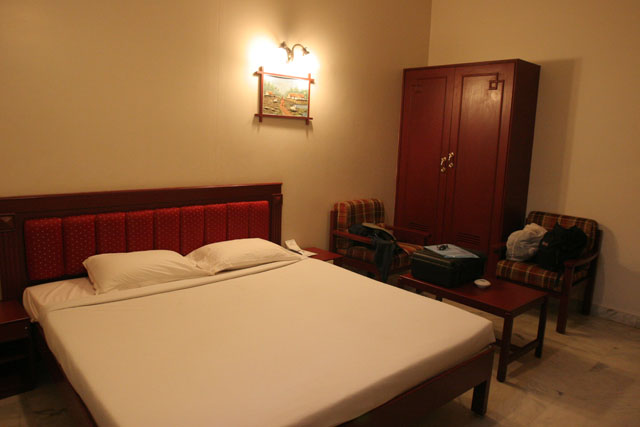
As I sit in my air conditioned hotel room watching Bollywood music videos I try to assimilate the days experiences and internalize them in some sort of coherent way. I've just driven though some of Indias least developed areas... now, only hours later, I'm watching obviously very hip (mostly Hindi speaking north Indian) actors dancing around in western cloths in extremely extravagant musical numbers. Being from Tinsel Town, I should "get it", after all, even during our depression Hollywood was cranking out the same sort of stuff. People everywhere prefer escapism in their entertainment. OK, now that I've thought that one though I can handle the disparity between what's on TV and what I see on the streets...
It's hard to face India head on and continue to think about everything you thought you knew about the world the same way. So far I've been coddled in the pseudo-India of Auroville. (What I call "training wheels for south India") But training wheels or no, nothing beats a 5 hour road trip to get a solid slap of south India in the face. My original ride to Auroville was similar, but for some reason certain things never sunk in. Let's call my state of mind today "rebound culture shock"... I'll provide details as I go...
Today I saw a lot of tenant farmers.
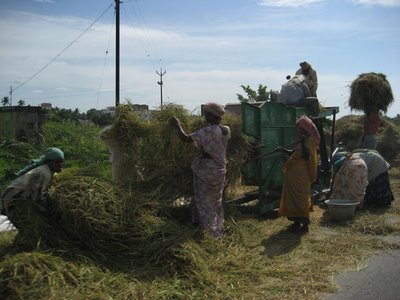 Tenant farming is never very profitable no matter where it is performed. I can't imagine things are any different in India than in the US in that regard. If anything, the profits are even worse here. It's hard for me to put what I'm thinking into words... On the one hand, I see obvious poverty... on the other hand, people "in the sticks" seem less poor, in many ways, compared to the people I see in the towns and the cities. If it wasn't for the intense population pressure on the land, one could say they actually live totally in tune with nature and sustainably. (Unlike anyplace in the west) Out in the rice paddys and cane fields, there isn't the kind of trash and pollution one sees in the cities. (There IS trash. But it isn't as bad) Beasts of burden are used for farming, along with basic machines like tractors and threshing machines. The only place they ARE exceeding the resources seems to be in the area of water usage. The crude "plumbing" in the boonies means that gray and even black water ends up in places it shouldn't be (like back in the fresh water) Again, if it weren't for the population pressure, the way things are done would be perfectly fine. Nature could handle it. But unfortunately, there are too many people and things are not done purely the "old way". Chemical fertilizers and other "modern" things are also being used. But with a few little tweaks to keep things sustainable and maybe upgrade the "plumbing" and things could go on that way forever. Realisticly, it's hard to look at the way food is currently produced and figure out how things could ever be "modernized" very quickly. What would all the people do for work? Even though the pay is bad, they wont have anyplace to go until everything else comes along. It's kind of a catch-22 situation. I'm certain that due to market pressure eventually it will change to be more like the west. It may take 100 years, but it will probably happen at some point in the name of progress. But will it be progress?
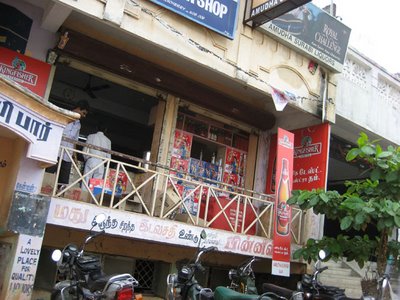
OK. The cities in India. The main problem is pollution and bad roads. My observations so far is that it's like an echo of the West. Or an imperfect reflection. Sure, there are motor vehicles and roads. But most of the roads seem like an after thought. And there are so many diesels and two strokes on the road that the air makes you nauseous. I don't even want to think about the industrial pollution. (I sure hope the government here is more responsible than China in that regard... but bribes are common here as well. I really, really hope that some greedy bastards aren't selling the health of their counties land and their countrymen for a few rupees) I can't wait to see more cities to get a better idea of what's going on in the cities though. I haven't seen enough yet to have more than a "first impression".
Then there is the fact that I'm staying in a hotel that the people on the street just outside could only dream about staying in. (most of them, if they are lucky enough to have a good steady job, probably only make 100-200 rupees a day... thats 2-4 dollars.) I'm wondering when the... guilt? will ware off. OK, it's not exactly guilt, I mean, I just happen to have been born in and live in a country whose economy and currency is strong. I'm also fortunate to have a decent job, even compared to many other USA-ians.
Ok, enough blather, I think you get the point. I'm trying to internalize a torrent of experience.
About the photos:
I knew It was going to be an interesting day when the first thing my driver did (after showing up late) was pull over to buy liqueur. He drinks a little at night... hm... I guess two liters of brandy might work out to "a little" spread out over two weeks. (He said he was stocking up because it's cheaper in Pondy compared to Tamil Nadu. Still, he blew a days pay on those two liters. (Yeah, that's 2 bucks for each liter of brandy)
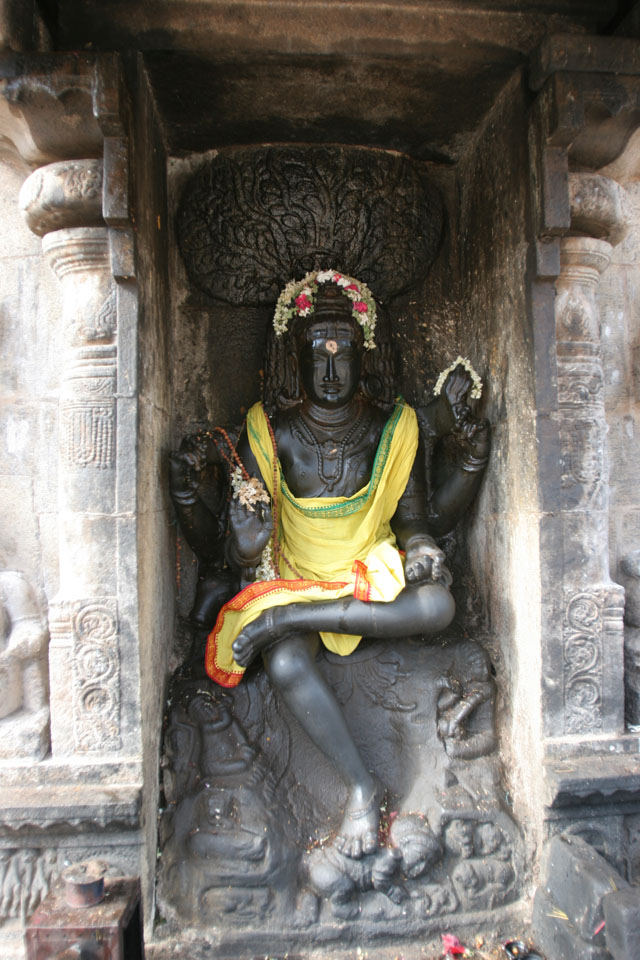
The first group of photos is from a temple called Chidambaram. It's like the Universal Studios of temples. Or the Disney Land. The brightly painted statues have been freshly restored, (It's done every 50 years... they are only 6 months old!) The temple is dedicated to Shiva, but the outside is completely covered with other statues as well. It's a private temple run by the Brahman priests who live there. Chidambaram is a really nice temple, but being hit-up for donations every ten feet got old pretty fast: "Hello! This is a private temple... What country you from? What is your good name? Please sign book. See how much these people pay? 300 and I do special puja for you!"
I'm not kidding. That's just how it was. I got jaded pretty quickly. At least they weren't hitting up the worshipers the same way. But then again, the worshipers pay donations without being asked... only much smaller donations than the ones the priests asked of me. I had to jam though this site anyway, since we needed to get back on the road to get to the next site. (Which IMHO was more interesting in a lot of ways)


This is what the priests looked like (photos are not allowed INSIDE the sanctum, which is where all the priests hang out)

An old guy outside the temple in traditional dress. Many men in south India still dress this way, not just old folks.

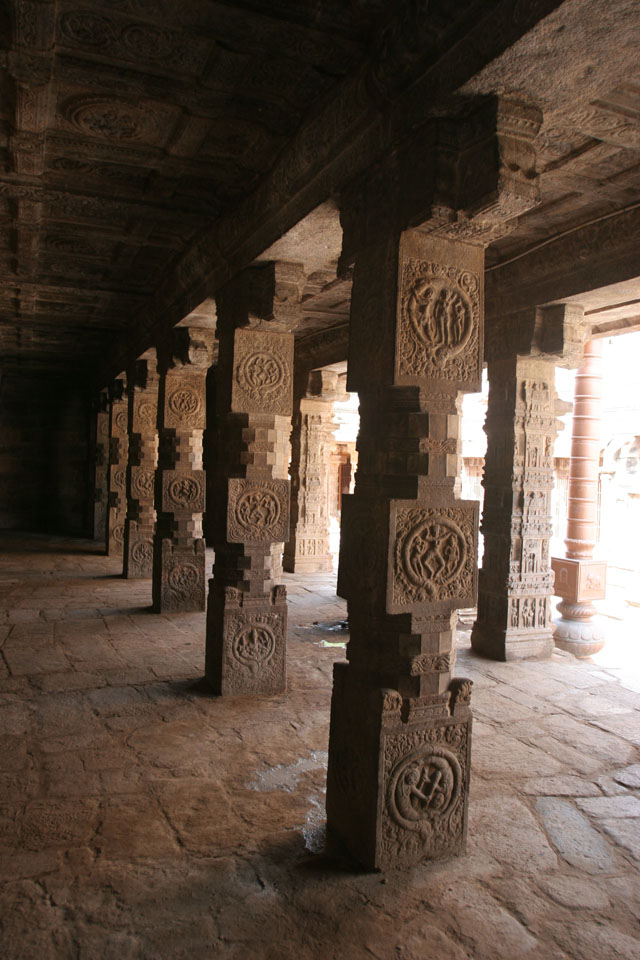
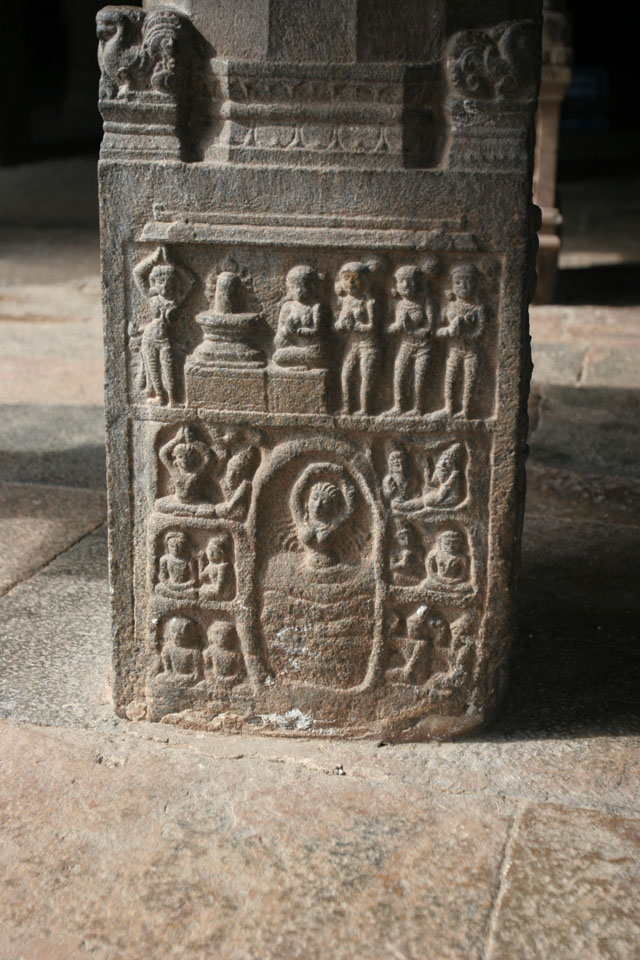
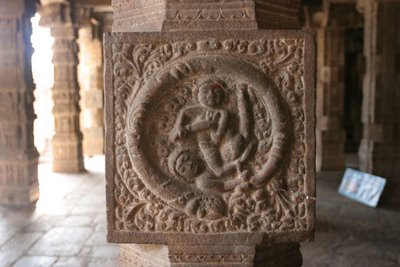
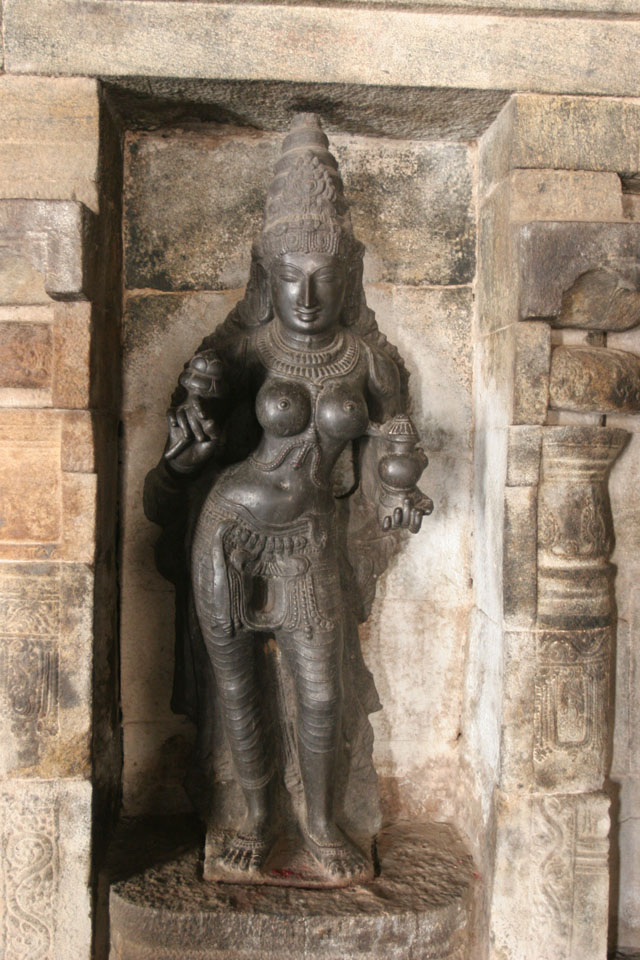
The second group of pictures is from a Chola era temple in Darasuram called Airavatesvara. It was completed in the 12th century and improved upon later in the 14th and16th century. (If I remember correctly)

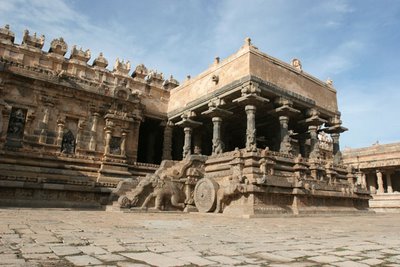
Every column is carved with intricate scenes depicting Shiva and his various exploits. Every inch of the place is basically covered with carvings. Some of them repeat but most are unique. It's totally mind blowing/numbing. (I'm not showing even a fraction of the photos I did take. It would take thousands of photos to document everything. I couldn't get the idea of image base modeling / lidar out of my head while looking at this place. It would be amazing to have a digital replica of it... of course the data set would be immense! )
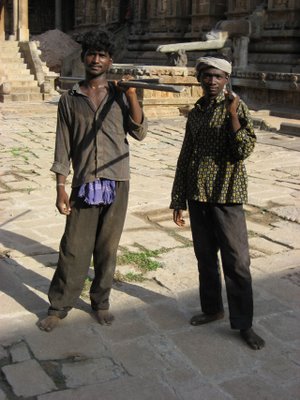
 Restoration workers:
 Cute kids outside temple. (Another one of the "take pictures of my cute kids" moments)
Weavers hand weaving silk sarees. A single saree takes 10 days to complete. These particular 10 day sarees sell for 2000 rupees ( $44) (Super fancy silk sarees go for up to 16000-25000 rupees)
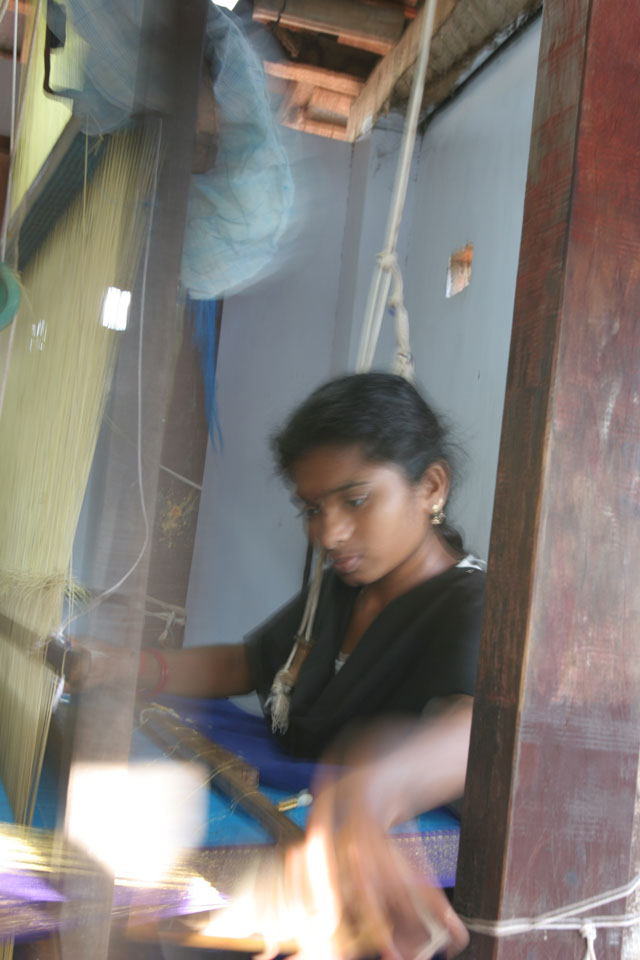
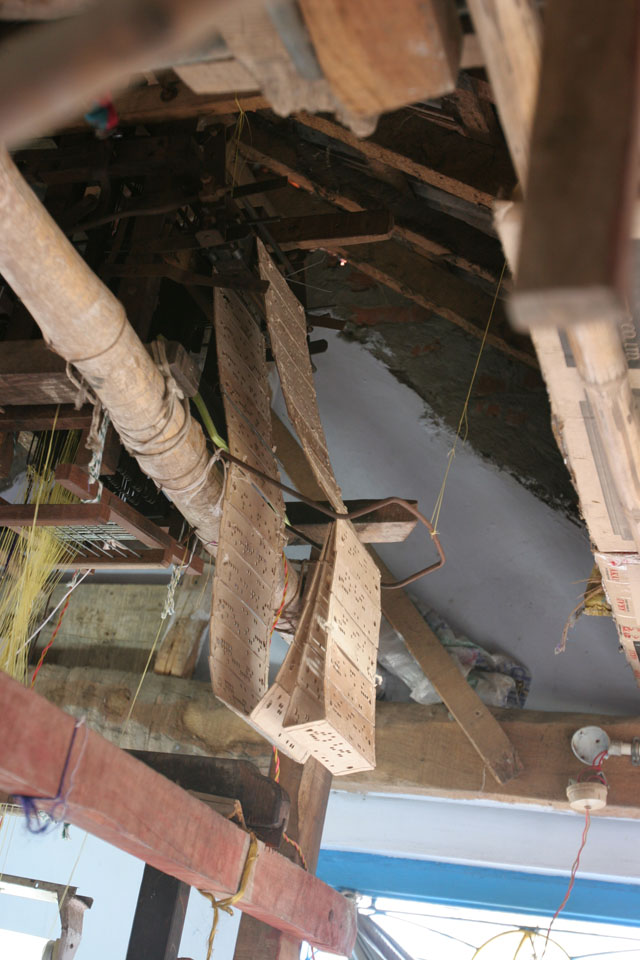
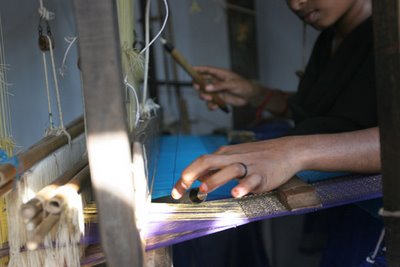 The brocade on the edge of the saree is done in a semi-automatic way with these punch card things and some fancy mechanics on the loom.
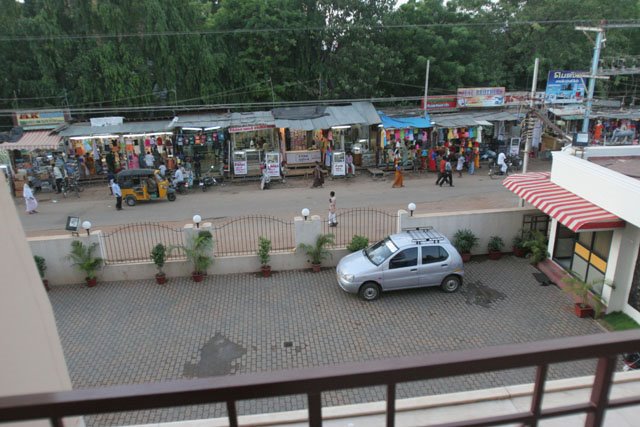
 Three stars is a huge improvement from cold and cold running frogs, an outdoor loo, and the smartest and most persistent damn mosquitoes you can imagine. Warm Water! Air conditioning! Glass windows! It's pure luxury!
My view. The little car in the right is my ride. It's a diesel Tata Indica. Tata is an Indian make. Seems OK. I'm keen to take a peek under the hood at some point.
After settling into the hotel and having dinner I decided to do a little shopping. It's official, I've gone lungi-crazy. I already have two lungis and a couple of dhotis, but I couldn't resist grabbing a couple more while I was getting some cute little dresses for my niece. A lungi is basically 2 meters of cloth, right off the loom, sewn into tube. There is no hem. The natural edge of the weave forms the hem. (The same is true for sarees and many othere articles of traditional indian clothing. There are rarely hem stitches) If you haven't figured it out already, it's worn like a skirt. There's more than one way to wrap or tie a lungi so it stays on. One of the nicer ways is to create a pair of pleats along the front and then roll the top down to hold it. I'll get some pictures to illustrate eventually.
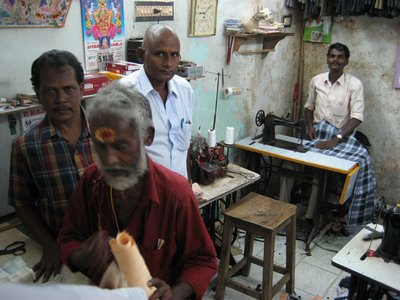
Lungis usually come un-stitched. But like most markets here in India, the market where I purchased the my new lungis had a tailor. They charged 10 rupees to stitch each. In the end my lungis were 95 rs all in. That's less than $2 for a functional piece of clothing... Try finding a meter of hand woven cotton anywhere in the States for a buck. The tailors use manual sewing machines. If you think about it, it makes sense given the number to power outages. Plus, manual sewing machines work perfectly well. No reason to over complicate things.
Whay are you guys so serious? I told a joke... smile! smile...
That's mroe like it!
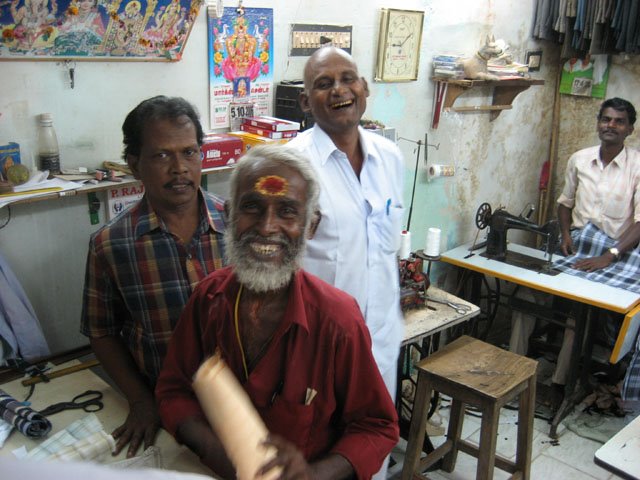 Manual sewing machine: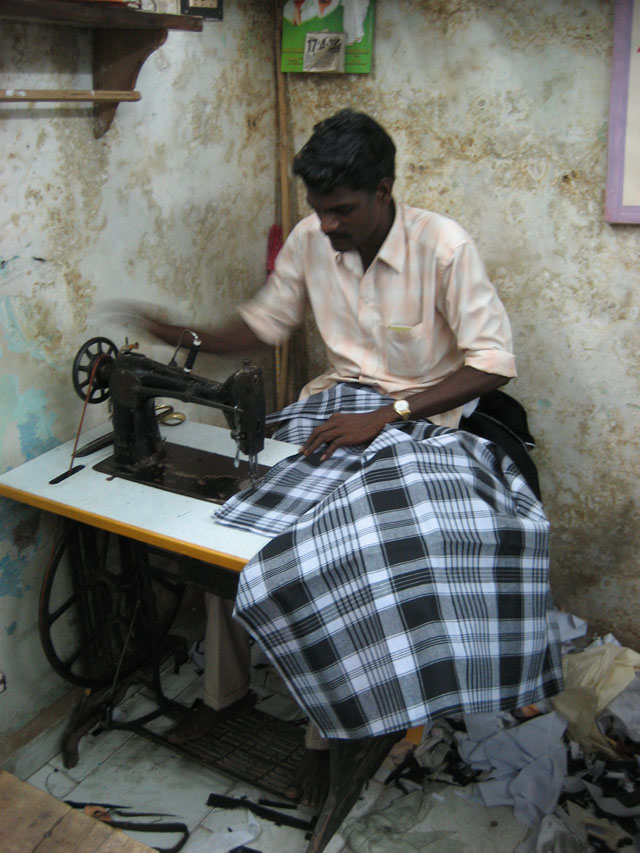





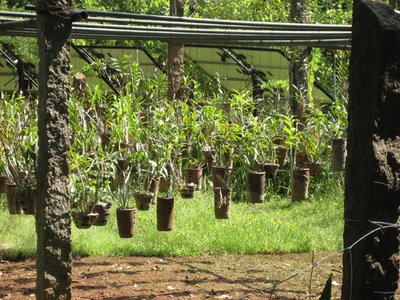
 Orchids in the Botanical Garden: